
QUICK ANSWER
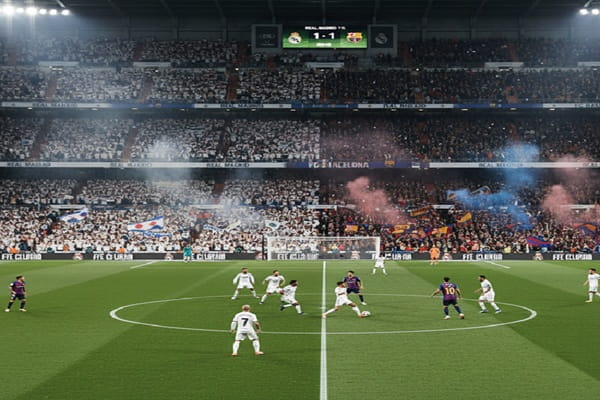
The Real Madrid vs FC Barcelona rivalry, known as El Clasico, began on May 13, 1902 and spans over 120 years of football history. Across more than 296 competitive meetings in La Liga, the Copa del Rey, and the UEFA Champions League, Barcelona leads the all-time head-to-head record with 124 wins to Real Madrid’s 108, with 64 draws. It is widely regarded as the greatest club rivalry in world football.
Contents
- 1 The Match That Stops the World
- 2 The Background: More Than a Football Match
- 3 The Political Dimension: Why El Clasico Became Personal
- 4 The Complete Real Madrid vs FC Barcelona Timeline
- 4.1 1899 to 1901: The Clubs Are Born
- 4.2 1902: The First Meeting
- 4.3 1902 to 1928: The Pre-League Era
- 4.4 1929: La Liga Changes Everything
- 4.5 1930s: Growing Intensity
- 4.6 1940s: Franco’s Shadow
- 4.7 1950s: The Di Stefano Affair and European Glory
- 4.8 1960s and 1970s: European Giants
- 4.9 1980s: Barcelona’s Cultural Renaissance
- 4.10 1990s: The Global Rivalry Arrives
- 4.11 2000s: Setting the Stage for History
- 4.12 2010 to 2014: The Guardiola-Mourinho Wars
- 4.13 2014 to 2018: The Champions League Era
- 4.14 2018 to 2022: Transition and Rebuilding
- 4.15 2023 to 2026: The New Era
- 5 Complete Head-to-Head Record and Statistics
- 6 The Greatest El Clasico Matches in History
- 6.1 November 1943: Copa del Rey Semi-Final, 11-1
- 6.2 January 1994: La Liga, 5-0 to Barcelona
- 6.3 May 2009: Copa del Rey Final, 6-2 to Barcelona
- 6.4 November 2010: La Liga, 5-0 to Barcelona
- 6.5 April 2011: Champions League Semi-Final
- 6.6 March 2014: Champions League, Ronaldo’s Hat-Trick Match
- 6.7 October 2025: La Liga, 2-1 to Real Madrid
- 6.8 January 2026: Spanish Super Cup Final, 3-2 to Barcelona
- 7 The Legendary Players Who Defined El Clasico
- 8 The Managerial Battles That Shaped El Clasico
- 9 Why El Clasico Remains Unmissable in 2026
- 10 Key Takeaways from the El Clasico Timeline
- 11 Frequently Asked Questions About Real Madrid vs FC Barcelona
- 11.1 When was the first El Clasico played?
- 11.2 Who has won more El Clasico matches all time?
- 11.3 Who has the most goals in El Clasico history?
- 11.4 Why is it called El Clasico?
- 11.5 How has politics shaped the El Clasico rivalry?
- 11.6 What is the biggest ever El Clasico victory?
- 11.7 Who are the key players in El Clasico today?
- 12 Conclusion: The Rivalry That Never Gets Old
The Match That Stops the World
There are football matches and then there is El Clasico.
No other club fixture on the planet carries the same weight. Not the Manchester Derby. Not the Milan Derby. Not even the North London rivalry between Arsenal and Tottenham. When Real Madrid and FC Barcelona face each other, an estimated 650 million people watch around the world. That is not a game. That is a global event.
But to understand why El Clasico matters so much, you cannot just look at the scorelines. You have to understand the history behind it, the politics that shaped it, the players who defined it, and the moments that made it impossible to look away. This timeline takes you through all of it, from the very first clash in 1902 right through to the most recent chapters being written in 2026.
The Background: More Than a Football Match
Before walking through the timeline, it is worth understanding what makes this rivalry so different from every other one in sport.
Real Madrid and FC Barcelona do not just represent two football clubs. They represent two completely different visions of Spain itself.
Barcelona was founded in 1899 and has always stood as a symbol of Catalan identity, independence, and regional pride. The club’s motto, Mes que un club, which translates to More than a club, is not marketing language. It is a genuine statement of cultural identity. The club’s famous youth academy La Masia and its commitment to a passing-based philosophy known as Tiki-taka are expressions of a distinct Catalan football culture.
Real Madrid, founded in 1902 and granted the title Real, meaning Royal, by King Alfonso XIII in 1920, has historically represented the Spanish capital and has connections to the Spanish state itself. The club built its reputation on signing the world’s greatest players and winning at the highest level, a philosophy that produced 14 UEFA Champions League titles, the most in the competition’s history.
When these two clubs meet, every goal, every tackle, and every moment carries the weight of this deeper story.
The Political Dimension: Why El Clasico Became Personal
The rivalry crossed from sporting into something far more visceral during the Spanish Civil War from 1936 to 1939 and the dictatorship that followed.
General Francisco Franco’s right-wing nationalist government won the Civil War and proceeded to suppress Catalan culture, language, and identity for nearly four decades. In 1939, Franco forced FC Barcelona to change their name to the Spanish equivalent, Barcelona CF, as a symbolic act of dominance. In 1943, Franco’s government allegedly applied pressure before a Copa del Rey semi-final between the two clubs, which Barcelona subsequently lost by the extraordinary score of 11-1, a result that still provokes debate about what actually happened in that dressing room before kick-off.
Supporting Barcelona in this era was not simply a sporting choice. It was a statement of resistance. It was a way for Catalans to assert their identity when their language was banned from public life and their culture was being suppressed by the state.
Real Madrid, benefiting from the regime’s favoritism, became associated in the minds of many Catalans with the central Spanish government that was persecuting their culture. Whether this association was entirely fair is a matter historians still debate, but the emotional reality of it shaped the rivalry for generations.
Even today, long after Franco’s death in 1975 and Spain’s transition to democracy, those cultural and political undercurrents remain present in El Clasico. They are why the rivalry means more than football and always will.
The Complete Real Madrid vs FC Barcelona Timeline
1899 to 1901: The Clubs Are Born
Barcelona are founded on November 29, 1899 by a group of Swiss, English, and Catalan footballers led by Hans Gamper. Real Madrid follow two years later in 1902, founded by a group of young football enthusiasts in the Spanish capital.
From the very beginning, the two clubs exist in different worlds. Barcelona in the industrial, proud, culturally distinct region of Catalonia. Madrid in the political capital of the Spanish state. The stage for everything that follows is already set.
1902: The First Meeting
The first ever official match between Real Madrid and FC Barcelona takes place on May 13, 1902, in the Copa de la Coronacion, a competition organized to celebrate the coronation of King Alfonso XIII. It is not yet an official national competition but it is the first time the two clubs face each other competitively.
Barcelona win that first encounter 3-1. It is a result that Barcelona fans still cite with pride over a century later. The seeds of rivalry are immediately present even if neither club fully understands yet what they are creating.
1902 to 1928: The Pre-League Era
For the first quarter of the 20th century, Real Madrid and Barcelona meet primarily in the Copa del Rey, which was known at the time as the Copa de Espana, the only national competition in existence. Matches are irregular and records are incomplete, but both clubs are clearly developing into the dominant forces in Spanish football.
Fan bases grow. Identities solidify. The regional dimension of the rivalry becomes clearer as Catalan nationalism strengthens in the 1920s. By this point, supporting one of these two clubs already means something beyond football for many fans on both sides.
1929: La Liga Changes Everything
The founding of La Liga in 1929 transforms El Clasico from an occasional cup encounter into a twice-yearly fixture with serious implications. Now there are league titles at stake. Every point separating these two clubs at the end of the season carries real weight.
Barcelona win the inaugural La Liga title in the 1929 season. Real Madrid finish in second place. The pattern of these two clubs dominating Spanish football from the very beginning of the league era is established immediately and continues without interruption to this day.
1930s: Growing Intensity
The rivalry intensifies through the 1930s as both clubs establish themselves as clear powerhouses of Spanish football. The political situation in Spain adds extra electricity to every encounter. The Spanish Civil War from 1936 to 1939 disrupts football significantly, with La Liga suspended during the conflict.
The tragic murder of Barcelona president Josep Sunyol by Nationalist forces in 1936 deepens the emotional connection between the club and the Catalan independence movement. By the time football resumes after the Civil War, El Clasico has a political charge that transforms the atmosphere around every match.
1940s: Franco’s Shadow
Football resumes under Franco’s dictatorship and Real Madrid benefit from the regime’s institutional support. The controversial 11-1 defeat of Barcelona in the 1943 Copa del Rey semi-final becomes one of the most debated results in the history of the rivalry.
Barcelona’s struggle to assert themselves in this era is not purely sporting. The suppression of Catalan culture under Franco means that every Barcelona victory carries an added dimension of defiance. Every time Barcelona beat Real Madrid in these years, it is felt as more than a football result in Catalonia.
1950s: The Di Stefano Affair and European Glory
The 1950s produce one of the most consequential and controversial episodes in El Clasico history: the battle for the signature of Alfredo Di Stefano.
The legendary Argentine forward reaches an agreement with FC Barcelona and even plays several friendly matches for the club. However, a dispute over player rights between River Plate and the Colombian club Millonarios allows Real Madrid to intervene. Real Madrid ultimately secure Di Stefano in a deal that remains disputed to this day, with many Barcelona supporters believing the Spanish Football Federation, under Franco’s influence, manipulated the situation in Madrid’s favor.
Di Stefano goes on to become the greatest player of his generation at Real Madrid, leading them to five consecutive European Cup titles between 1956 and 1960. Barcelona are left to wonder how differently history might have unfolded.
This episode deepens the suspicion and bitterness between the clubs in a way that decades of ordinary sporting competition could not have achieved. It remains one of the defining stories in the rivalry’s history.
1960s and 1970s: European Giants
Both clubs emerge as genuine European powerhouses in this era. Real Madrid continue to dominate La Liga and the European Cup under the influence of Di Stefano and later Hungarian legend Ferenc Puskas. Barcelona, featuring stars like László Kubala, respond with periods of domestic success and growing ambition.
The matches between them are among the most anticipated events in European football. Television begins to spread El Clasico beyond Spain’s borders. A rivalry that had been primarily a Spanish affair begins its journey toward becoming a global spectacle.
1980s: Barcelona’s Cultural Renaissance
Johan Cruyff arrives at Barcelona as a player in 1973 and returns as manager in 1988, transforming the club’s philosophy and self-image in ways that echo to the present day. Cruyff’s Dream Team wins four consecutive La Liga titles from 1991 to 1994 and Barcelona’s first European Cup in 1992, ending decades of frustration at the highest level.
Real Madrid respond with their own periods of dominance. The rivalry in this era is defined by contrasting football philosophies. Barcelona’s commitment to possession-based, attacking football versus Real Madrid’s more pragmatic approach to winning by whatever means necessary. These philosophical differences add another layer of identity to every encounter.
1990s: The Global Rivalry Arrives
Satellite television and the expanding global appetite for football transforms El Clasico into a truly worldwide event in the 1990s. Matches that were once primarily watched in Spain are now broadcast across Asia, the Americas, Africa, and beyond.
Both clubs pursue the Galacticos strategy of signing the world’s biggest stars. Real Madrid bring in Ronaldo, Roberto Carlos, Zinedine Zidane, and Luis Figo. Barcelona respond with Rivaldo, Patrick Kluivert, and others. The rivalry acquires a star power dimension that makes every Clasico a showcase of the best footballers on the planet.
The Luis Figo transfer in 2000 creates one of the most infamous moments in the rivalry’s history. Figo, who had been a beloved star at Barcelona, is signed by Real Madrid after incoming club president Florentino Perez includes the signing as a pledge in his election campaign. When Figo returns to the Camp Nou with Real Madrid in November 2002, he is met with bottles, coins, mobile phones, and notoriously a pig’s head thrown from the stands. It remains one of the most vivid illustrations of how deeply personal this rivalry runs.
2000s: Setting the Stage for History
The early 2000s see both clubs assembling squads of extraordinary talent while alternating periods of domestic dominance. Real Madrid win La Liga in 2001, 2003, and 2007. Barcelona respond with titles in 2005, 2006, and 2009 as Pep Guardiola’s revolution begins to take shape.
In 2009, Guardiola’s Barcelona win the treble of La Liga, Copa del Rey, and Champions League, becoming the first Spanish club to achieve this feat. The squad, built around Xavi, Andres Iniesta, and a young Lionel Messi, plays a style of football so dominant and beautiful that it immediately enters the conversation as one of the greatest club sides in history.
Real Madrid respond by appointing Jose Mourinho as manager in 2010. The stage is set for the most intense period in the rivalry’s modern history.
2010 to 2014: The Guardiola-Mourinho Wars
This period represents perhaps the most ferociously contested era in El Clasico history. The Guardiola versus Mourinho managerial rivalry, combined with the Messi versus Ronaldo individual battle, creates a level of intensity that rivals anything the fixture has produced in its 120-year history.
In November 2010, Barcelona defeat Real Madrid 5-0 at the Camp Nou in what becomes one of the most referenced results in the rivalry’s history. The scoreline reflects Barcelona’s utter dominance in this period. Guardiola’s side pass the ball with a fluency that makes one of the world’s richest clubs look completely helpless.
Both sides meet an extraordinary four times in 18 days in April and May 2011 across La Liga, Copa del Rey, and Champions League. Barcelona win the Copa del Rey final. Real Madrid win the Champions League semi-final across two legs. The intensity of these weeks becomes legendary in football history.
In the 2011-12 season, Real Madrid win La Liga with a record 100 points, breaking Barcelona’s stranglehold on the title. Mourinho’s Madrid are relentless, physical, and devastatingly effective. But Guardiola’s Barcelona win the Champions League that season to maintain their status as Europe’s supreme club side.
Cristiano Ronaldo scores in six consecutive El Clasico matches during this era, netting seven goals across that streak. It is the best individual goalscoring run in the fixture’s history.
2014 to 2018: The Champions League Era
Real Madrid enter perhaps the most dominant period in Champions League history, winning the competition three times in four seasons under Carlo Ancelotti and then Zinedine Zidane. Cristiano Ronaldo is at the absolute peak of his powers, breaking record after record.
Barcelona respond with their second treble in 2015 under Luis Enrique, featuring the devastating attacking trio of Messi, Neymar, and Luis Suarez.
El Clasico matches in this era are defined by the individual performances of Messi and Ronaldo. Their personal records in the fixture become part of football folklore. Messi makes 45 El Clasico appearances and scores 26 goals, the most in the fixture’s history. Ronaldo makes 30 appearances and scores 18 goals, a tally he shares with the legendary Alfredo Di Stefano. Messi scores two hat-tricks against Real Madrid. Ronaldo never manages one against Barcelona.
2018 to 2022: Transition and Rebuilding
Cristiano Ronaldo’s departure from Real Madrid to Juventus in 2018 marks the end of one era. The Messi versus Ronaldo dimension of El Clasico disappears with it.
Both clubs enter periods of transition and genuine vulnerability. Real Madrid endure an inconsistent period before rebuilding around younger talents. Barcelona face a financial crisis of enormous proportions that forces them to release Messi in 2021, ending his 21-year association with the club.
Despite the disruption, El Clasico retains its capacity for drama. The rivalry between the clubs does not need two GOAT-level players on opposite sides to produce compelling football. The identity and culture of each club drives the intensity regardless of who is on the pitch.
Real Madrid win La Liga in the 2019-20 season. Barcelona win it in 2022-23. The cycle of alternating dominance that has defined the rivalry since 1929 continues unchanged.
2023 to 2026: The New Era
The post-Messi and post-Ronaldo era brings new faces to El Clasico and new narratives to the rivalry’s ongoing story.
Real Madrid build around Vinicius Junior, Kylian Mbappe, who joins from Paris Saint-Germain in the summer of 2024, Jude Bellingham, and a core of experienced winners. Barcelona develop Lamine Yamal, one of the most exciting young talents in world football, alongside Raphinha, Robert Lewandowski, and a rebuilt squad under manager Hansi Flick.
In October 2025, Real Madrid end a difficult run of results with a 2-1 victory at the Santiago Bernabeu. The win is celebrated with the kind of intensity that demonstrates how even a single Clasico result can reshape the narrative of an entire season.
On January 11, 2026, Barcelona beat Real Madrid 3-2 in the Spanish Super Cup final in a match of exceptional quality and drama that immediately enters the conversation among the great modern Clasico encounters.
Marcus Rashford and Jude Bellingham both make significant impacts on El Clasico in the 2025-26 season, with their individual performances rewriting records for their respective clubs in the fixture. The rivalry continues to produce new legends with each passing season.
Complete Head-to-Head Record and Statistics
All Competitive Matches Combined | Real Madrid | Barcelona | Draws Total competitive meetings | 108 wins | 124 wins | 64 draws La Liga meetings | Approx 180 matches | Leading record | Multiple draws Copa del Rey meetings | Multiple titles | Multiple titles | Several draws Champions League meetings | 14 UCL titles | 5 UCL titles | N/A All-time La Liga titles | 35 titles | 27 titles | N/A All-time Champions League | 14 titles | 5 titles | N/A Total trophies all competitions | 69 titles | 77 titles | N/A
The Greatest El Clasico Matches in History
November 1943: Copa del Rey Semi-Final, 11-1
The most controversial result in the rivalry’s history. Real Madrid defeat Barcelona 11-1 in circumstances that have never been satisfactorily explained. Many Barcelona historians point to alleged interference by Franco’s regime before the match. The result remains disputed and painful in Catalan football memory.
January 1994: La Liga, 5-0 to Barcelona
Johan Cruyff’s Dream Team demolish Real Madrid at the Camp Nou in one of the most emphatic Clasico victories of the modern era. The result symbolizes Barcelona’s dominance under Cruyff’s revolutionary football philosophy.
May 2009: Copa del Rey Final, 6-2 to Barcelona
Guardiola’s Barcelona, on their way to the historic treble, destroy Real Madrid by an extraordinary scoreline in the Copa del Rey final. It is one of the most one-sided Clasico results in history and serves as a statement of intent for what the Guardiola era will become.
November 2010: La Liga, 5-0 to Barcelona
Perhaps the most famous result in the modern history of El Clasico. Barcelona’s 5-0 destruction of Real Madrid at the Camp Nou under Guardiola is a performance of such complete dominance that it enters football history as a benchmark for tactical supremacy. Real Madrid’s players look helpless throughout.
April 2011: Champions League Semi-Final
Barcelona and Real Madrid meet in the Champions League semi-finals in one of the most anticipated ties in the competition’s history. Real Madrid progress over two legs despite Barcelona’s domestic dominance, with Mourinho and Guardiola’s tactical battle adding an extra layer of intrigue to every moment.
March 2014: Champions League, Ronaldo’s Hat-Trick Match
Cristiano Ronaldo scores a hat-trick against Barcelona in the Copa del Rey and delivers a stunning individual performance in the Champions League era. His individual brilliance during this period of the rivalry defines the Messi versus Ronaldo chapter.
October 2025: La Liga, 2-1 to Real Madrid
Real Madrid’s 2-1 victory at the Bernabeu ends a challenging run and demonstrates the club’s resilience in the post-Mbappe arrival era. Jude Bellingham and Vinicius Junior are central to the performance.
January 2026: Spanish Super Cup Final, 3-2 to Barcelona
An extraordinary match of the highest quality. Barcelona defeat Real Madrid 3-2 in the Spanish Super Cup final in a game featuring exceptional individual performances from Lamine Yamal and the tactical fingerprints of Hansi Flick’s possession-based approach. The match is immediately recognized as one of the great modern Clasico encounters.
Also Read : FC Barcelona vs Real Valladolid Timeline
The Legendary Players Who Defined El Clasico
Alfredo Di Stefano (Real Madrid)
The Argentine genius who could have been a Barcelona player instead became the defining figure of Real Madrid’s first great European era. His theft from Barcelona’s grasp remains one of the rivalry’s most contentious moments. He shares the record of 18 El Clasico goals with Cristiano Ronaldo.
Lionel Messi (Barcelona)
The all-time record holder for El Clasico appearances with 45 matches and for goals scored with 26. Messi scored two hat-tricks against Real Madrid and produced some of his most transcendent individual performances in this fixture. His association with El Clasico is inseparable from his status as arguably the greatest footballer who ever lived.
Cristiano Ronaldo (Real Madrid)
Eighteen El Clasico goals, a record six consecutive matches scored, and individual performances of breathtaking quality. Ronaldo’s battles with Messi in this fixture gave the rivalry a new dimension that captured the imagination of a generation of football fans worldwide.
Johan Cruyff (Barcelona, player and manager)
As a player in the early 1970s and then as the manager of the legendary Dream Team from 1988 to 1994, Cruyff’s influence on Barcelona’s identity is unmatched. His philosophy of attacking, possession-based football gave the club a distinct style that defines El Clasico encounters to this day.
Zinedine Zidane (Real Madrid, player and manager)
As a player, Zidane delivered extraordinary individual moments in El Clasico. As a manager, he led Real Madrid to three consecutive Champions League titles, establishing himself as the most successful coach in the competition’s history and cementing his legacy in the rivalry’s modern era.
Lamine Yamal (Barcelona)
The teenage sensation born in 2007, who represents the next chapter of El Clasico history. Yamal’s performances in the 2025-26 season against Real Madrid have already drawn comparisons to the greatest players to have graced this fixture. At 17 years old, he is already writing his name into Clasico history.
The Managerial Battles That Shaped El Clasico
Great managers define eras of El Clasico just as great players do. The fixture has been shaped by tactical masterminds whose approaches to the game reflected the wider identities of their clubs.
Pep Guardiola versus Jose Mourinho from 2010 to 2012 represents the most intense managerial rivalry in the fixture’s modern history. Guardiola’s Barcelona played the most sophisticated possession football the game had ever seen. Mourinho’s Real Madrid pursued winning through tactical discipline, defensive solidity, and the unleashing of Cristiano Ronaldo’s individual brilliance. Their rivalry was personal, intense, and productive of some of the most gripping football theatre in the sport’s history.
Carlo Ancelotti oversaw Real Madrid during two separate spells at the club and delivered La Liga and Champions League success in both. His calm authority and man-management ability created the environment for Ronaldo and later Vinicius and Mbappe to perform at their peak in El Clasico.
Luis Enrique led Barcelona to their 2015 treble and produced some of the finest El Clasico performances of that decade, working with the devastating Messi, Neymar, Suarez attacking line that many consider the greatest attacking trio in football history.
Hansi Flick, arriving at Barcelona for the 2024-25 season, has immediately established a high-pressing, technically demanding style that has reinvigorated the club and produced impressive El Clasico performances in the 2025-26 campaign.
Why El Clasico Remains Unmissable in 2026
Some rivalries fade when the exceptional players move on. El Clasico does not follow that pattern.
The rivalry between Real Madrid and Barcelona is self-sustaining because it is rooted in something far deeper than the individuals who play in it. The cultural, political, and regional dimensions that gave El Clasico its unique charge in the 1940s have softened with Spain’s democratic transformation but never disappeared entirely. When these two clubs meet, those historical layers are always present in the atmosphere even if most viewers are simply watching for the football.
The quality of football in the 2025-26 era is extraordinary. Lamine Yamal and Vinicius Junior represent two of the most exciting players on the planet. Kylian Mbappe, Jude Bellingham, and Robert Lewandowski add star power that ensures El Clasico remains the most watched club match on earth.
The head-to-head record remains genuinely competitive. Barcelona’s all-time lead of 124 wins to Real Madrid’s 108 demonstrates that neither club has ever been able to establish lasting dominance. The pendulum swings. Eras come and go. New heroes emerge. That cyclical uncertainty is part of what keeps 650 million viewers watching every time these two clubs meet.
Key Takeaways from the El Clasico Timeline
El Clasico began in 1902 and has been played across more than 296 competitive matches over 124 years.
Barcelona lead the all-time head-to-head record with 124 wins to Real Madrid’s 108, with 64 draws.
Real Madrid lead in La Liga titles with 35 to Barcelona’s 27 and in Champions League titles with 14 to Barcelona’s 5.
Barcelona have won more total trophies across all competitions with 77 to Real Madrid’s 69.
The political dimension of the rivalry during Franco’s dictatorship from 1939 to 1975 gave El Clasico a cultural significance that extends far beyond football.
The Messi versus Ronaldo era produced the most watched and most discussed individual battle in the fixture’s history.
Lionel Messi holds the all-time El Clasico records for appearances (45) and goals scored (26).
The rivalry continues to evolve with new stars in 2026 including Lamine Yamal, Vinicius Junior, and Kylian Mbappe.
Frequently Asked Questions About Real Madrid vs FC Barcelona
When was the first El Clasico played?
The first official meeting between Real Madrid and FC Barcelona took place on May 13, 1902, in the Copa de la Coronacion. Barcelona won that match 3-1. Their first La Liga encounter came after the league’s founding in 1929.
Who has won more El Clasico matches all time?
Barcelona leads the all-time head-to-head record in competitive matches with 124 wins, compared to Real Madrid’s 108 wins and 64 draws across more than 296 total meetings.
Who has the most goals in El Clasico history?
Lionel Messi holds the record with 26 goals in 45 El Clasico appearances. Cristiano Ronaldo scored 18 goals in 30 appearances, a tally he shares with the legendary Alfredo Di Stefano.
Why is it called El Clasico?
The term El Clasico, meaning The Classic, came into widespread use at the turn of the 21st century. Before that, the match was commonly referred to as El Derbi or simply as Madrid-Barca. The name is believed to have been influenced by the use of the word clasico in South and Central American football culture to describe important derby matches.
How has politics shaped the El Clasico rivalry?
The rivalry’s political dimension deepened during and after the Spanish Civil War from 1936 to 1939. Francisco Franco’s dictatorship suppressed Catalan culture and identity, making support for Barcelona an act of cultural resistance. Real Madrid became associated with the central Spanish government. These dimensions shaped the emotional intensity of El Clasico for decades and their echoes are still present today.
What is the biggest ever El Clasico victory?
Real Madrid’s 11-1 victory over Barcelona in the 1943 Copa del Rey is technically the largest margin of victory in the rivalry’s history, though the circumstances of that result remain deeply controversial. In the modern era, Barcelona’s 5-0 victory in November 2010 under Pep Guardiola is widely considered the most emphatic result of the contemporary game.
Who are the key players in El Clasico today?
The 2025-26 El Clasico features players of extraordinary quality on both sides. For Barcelona, Lamine Yamal, Raphinha, and Robert Lewandowski are central figures. For Real Madrid, Vinicius Junior, Kylian Mbappe, and Jude Bellingham carry the biggest individual responsibilities. Both squads have the depth and quality to produce exceptional Clasico performances.
Conclusion: The Rivalry That Never Gets Old
One hundred and twenty-four years. More than 296 competitive matches. Titles, scandals, political dramas, individual masterclasses, controversial results, and moments of pure football genius that no other rivalry has produced with such frequency.
The Real Madrid versus FC Barcelona timeline is not just a record of football matches. It is a record of Spanish history, of human passion, of what happens when sport becomes the vessel for everything a community believes in and wants to assert about itself. Every El Clasico adds a new line to that story. Every goal, every red card, every moment of individual brilliance becomes part of a living archive that stretches back more than a century.